Virtual agent services are reshaping how organizations handle customer interactions, internal support, and sales engagement. By leveraging AI call center technology, these digital assistants manage thousands of conversations in parallel, deliver instant answers, and free your human teams to focus on high-value tasks. Enhancing contact center operations with AI, virtual agents are no longer a nice-to-have but a strategic advantage for growing businesses and enterprises alike.
In today’s business, integrating virtual agent services with modern computer technology infrastructure allows organizations to automate repetitive tasks, streamline complex workflows, and maintain reliable cloud-based systems that support remote operations and scalable growth. Cloud computing combined with AI makes it possible to store, process, and analyze massive amounts of data efficiently, improving both operational performance and strategic decision-making.
In finance, AI-driven virtual agents help institutions monitor transactions, identify unusual patterns for fraud detection, predict financial trends, and optimize customer account management, creating safer and smarter financial services. Meanwhile, marketing and digital marketing are being transformed as AI tools assist in analyzing customer behaviors, segmenting audiences, automating personalized campaigns, improving email and social media strategies, and generating actionable insights to increase engagement and revenue.
By combining virtual agent services with these AI-enhanced systems in cloud computing, advanced computer networks, finance, and digital marketing, businesses can achieve seamless customer communication, more efficient operational management, and stronger growth strategies. This integrated approach ensures that organizations not only deliver faster and smarter customer experiences but also leverage technology to drive innovation and competitive advantage across multiple sectors.
Why Bright Pattern Stands Out - Top Contact Center & Virtual‑Agent Platforms
Bright Pattern
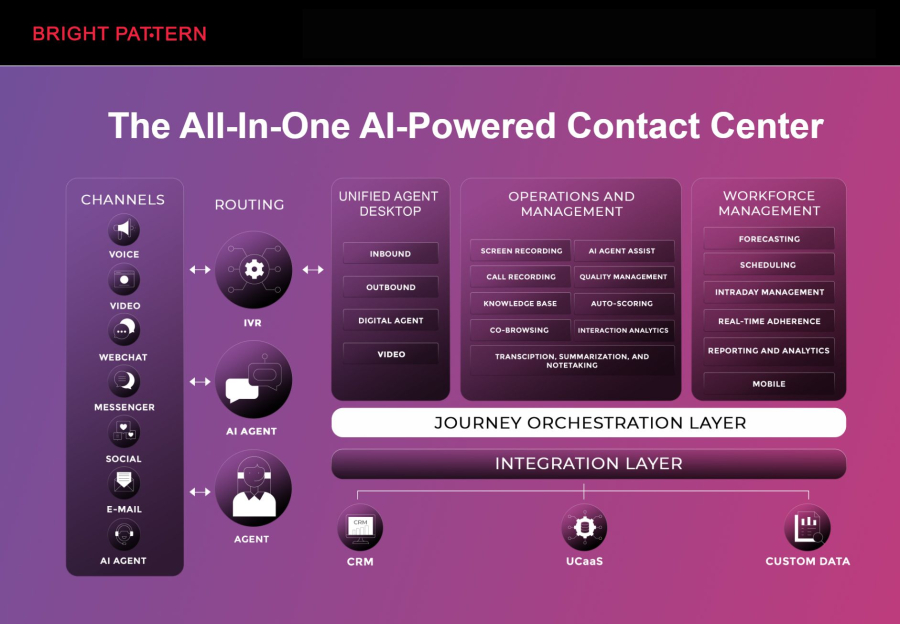
Bright Pattern combines powerful cloud‑based architecture with robust AI and omnichannel support to deliver one of the most flexible virtual agent services and contact center solutions on the market.
- Full cloud contact center software — Because it’s cloud‑native, Bright Pattern enables rapid deployment and avoids the cost and complexity of legacy on‑premise systems.
- Omnichannel support — Agents and virtual agents can handle interactions via voice, chat, SMS, social media, mobile apps, and more — all from a unified platform.
- CRM integration & unified agent desktop — It integrates with major CRM systems, giving agents instant access to customer history for personalized service.
- AI‑powered automation and assistance — From AI-powered bots to AI-assisted live agents, sentiment and text analysis, and automated workflow — it supports advanced automation while preserving human handover when needed.
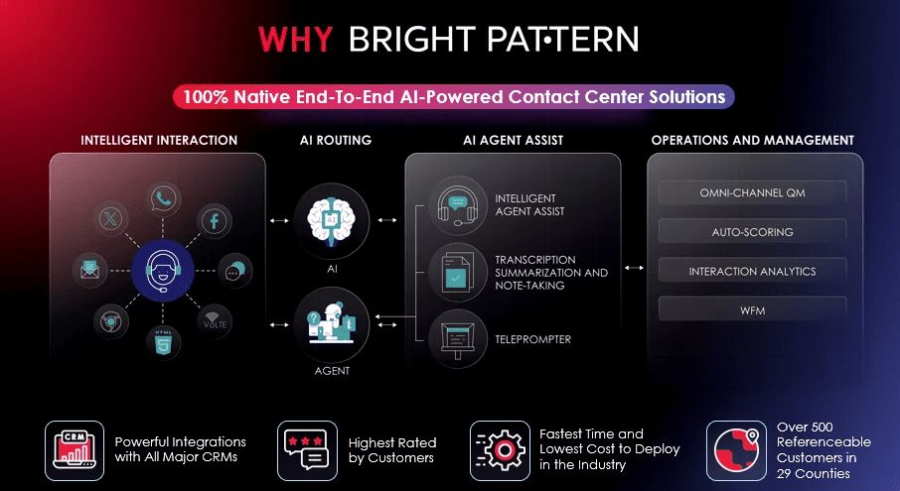
- Faster ROI and easier setup — According to users, Bright Pattern delivers one of the fastest return-on-investments in the industry, and can be implemented in a matter of weeks.
Because of these strengths, Bright Pattern often ranks among the top choices for businesses seeking modern, AI‑enhanced virtual agent services and cloud contact center infrastructure that scales with growth.
Other Leading Contact Center & Virtual‑Agent Platforms to Consider
Here are nine notable competitors to Bright Pattern — each with their own strengths.
- Genesys Cloud CX — Widely regarded as a top enterprise‑grade CCaaS (Contact Center as a Service) solution. Offers omnichannel routing, strong AI‑driven automation, analytics, and workforce optimization — well suited for large or scaling organizations.
- Five9 (Intelligent Cloud Contact Center Platform) — Known for its reliability, automatic call distribution, intelligent routing, CRM integration, and ease of use for both inbound and outbound contact centers.
- NICE CXone (Mpower) — A strong cloud contact center solution with omnichannel capabilities, AI-driven automation, and analytics. Good choice for companies seeking comprehensive contact center functionality.
- Talkdesk — A popular, cloud-native option that supports multichannel communication, and integrates smoothly with CRM and help‑desk tools. Often praised for ease of use and fast deployment.
- RingCentral Contact Center — Offers robust omnichannel communications, unified communications integration, and scalability — suitable for both small businesses and large enterprises.
- 8x8 Contact Center — A flexible cloud contact center solution that blends voice, chat, video, SMS, and email, offering unified communications plus contact center in one package — attractive for businesses wanting an integrated approach.
- Cisco Webex Contact Center — Enterprise‑grade contact center software that leverages Cisco’s network and collaboration expertise. Offers security, scalable infrastructure, and omnichannel support, suitable for global organizations.
- Nextiva Contact Center — Known for unified communications plus contact center features. Offers voice, digital channels, analytics, workforce management — practical for companies looking to combine phone system and contact center.
- CloudTalk — A simpler, more SMB‑friendly option — delivers cloud‑based VoIP and contact center capabilities, integrating with CRM/help‑desk systems and suitable for smaller teams or businesses
What Are Virtual Agent Services?
Virtual agent services combine conversational AI, automation workflows, and integration with your systems to simulate a human-like agent. They can understand questions, provide personalized responses, and execute routine tasks across multiple channels.
Depending on your needs, virtual agents can be deployed as:
- Customer-facing virtual agentsthat handle support, FAQs, onboarding, and basic sales queries.
- Internal virtual agentsthat assist employees with IT helpdesk, HR questions, and policy guidance.
- Sales and marketing assistantsthat qualify leads, recommend products, and nurture prospects.
Unlike simple chatbots with rigid scripts, modern virtual agent services use natural language understanding to capture intent, adapt to context, and continuously improve through data.
Key Business Benefits of Virtual Agent Services
Well-implemented virtual agent services deliver measurable results across cost savings, customer satisfaction, and operational efficiency.
1. 24/7 Support Without Expanding Headcount
Customers and employees expect instant answers at any time of day. Virtual agents meet this expectation by providing:
- Always-on availabilityacross time zones and weekends.
- No wait timesfor simple or repetitive queries.
- Consistent service qualityregardless of volume spikes.
Instead of recruiting and training around-the-clock human support, you can let a virtual agent handle routine volume while your team focuses on complex, relationship-driven work.
2. Lower Service Costs and Higher Efficiency
Virtual agent services dramatically reduce the cost per interaction. A single system can manage thousands of conversations simultaneously, with no overtime or extra staffing. Benefits include:
- Reduced call center loadby deflecting repetitive inquiries before they reach human agents.
- Shorter average handle timeswhen virtual agents gather context and data before transferring to a person.
- Optimized staffingbecause teams can be sized for complex cases rather than basic questions.
3. Better Customer Experience and Faster Resolution
Customers care most about getting accurate answers quickly. Virtual agents support that by:
- Instant responsesto frequent questions like order status, password reset, or policy details.
- Personalized assistanceusing data from your CRM, ticketing, or commerce platform.
- Seamless handoffto human agents when issues become complex or emotional.
When designed correctly, virtual agents remove friction from the customer journey and raise satisfaction, without removing access to human support when it is needed.
4. Scalable Support for Growth and Peak Demand
Growth brings more customers, more orders, and more inquiries. Traditional teams struggle to scale without high hiring and training costs. Virtual agent services help by:
- Absorbing traffic spikesduring launches, seasonal peaks, or crises.
- Scaling globallyacross languages and regions with consistent knowledge and tone.
- Maintaining service levelseven when demand exceeds human capacity.
5. Rich Data and Actionable Insights
Every interaction with a virtual agent can be tracked, analyzed, and used to improve service. Organizations gain:
- Real-time analyticson topics, sentiment, volume, and resolution rates.
- Visibility into emerging issuesbefore they become widespread problems.
- Continuous optimizationof content, workflows, and knowledge based on live data.
This data-driven feedback loop turns your virtual agent into a strategic source of customer intelligence.
Common Use Cases for Virtual Agent Services
Virtual agents can be designed for almost any industry or function, but a few use cases deliver especially strong impact.
Customer Service and Support
- Answering FAQs about pricing, policies, and product features.
- Handling account and profile questions, including simple updates.
- Providing order status, shipping information, and return guidance.
- Helping customers troubleshoot common technical issues.
- Routing complex cases to the right human expert with full context.
IT Helpdesk Automation
- Resetting passwords or unlocking accounts using secure workflows.
- Guiding employees through common software setup or configuration.
- Logging and categorizing tickets automatically in your IT system.
- Providing self-service knowledge articles tailored to each issue.
HR and Employee Services
- Answering questions about benefits, leave, and company policies.
- Collecting onboarding information from new hires.
- Helping employees find training resources or internal documents.
- Supporting managers with policy reminders and process steps.
Sales, Pre-Sales, and Lead Qualification
- Engaging site visitors or app users with proactive assistance.
- Answering basic product or service questions in real time.
- Qualifying leads by asking structured questions and scoring responses.
- Booking meetings or demos directly into calendars.
How Virtual Agent Services Work Behind the Scenes
Modern virtual agents rely on a combination of AI, automation, and integration. While technical details can be complex, the core components are straightforward.
Natural Language Understanding
Natural language understandingallows the virtual agent to interpret everyday human language. Instead of relying on exact keywords, it identifies the user’s intent and relevant details. This makes conversations more flexible and intuitive.
Knowledge and Content Management
Virtual agents draw information from structured and unstructured sources such as FAQs, help centers, policy documents, and product catalogs. A clear, well-maintained knowledge base helps the agent respond accurately and stay up to date as information changes.
Automation and Workflows
Beyond answering questions, virtual agents can trigger automated workflows. Examples include:
- Creating or updating support tickets.
- Initiating returns or exchanges based on eligibility rules.
- Checking order status in your commerce system.
- Updating user details or preferences in your CRM.
System Integrations
Integrations connect the virtual agent with tools you already use. Common connections include:
- Customer relationship management platforms for personalization.
- Helpdesk and ticketing tools for case management.
- HR and payroll platforms for employee self-service.
- Commerce platforms for orders, inventory, and returns.
Omnichannel Delivery
Virtual agent services can live wherever your users already are, including:
- Websites and mobile apps.
- Messaging channels.
- Voice assistants or interactive voice response systems.
- Internal collaboration tools for employee support.
This omnichannel presence ensures consistent experiences, whether users are browsing on a laptop, calling your hotline, or messaging from their phone.
Designing an Effective Virtual Agent Strategy
Getting maximum value from virtual agent services starts with a smart strategy. The most successful implementations share a few traits.
1. Clear Objectives and Success Metrics
Define what success looks like early. Objectives might include:
- Reducing call or chat volume by a specific percentage.
- Improving first-contact resolution.
- Shortening response or wait times.
- Increasing self-service adoption.
Establish baseline metrics and set targets so you can track impact and refine your approach over time.
2. High-Value Use Cases First
Start with the areas where virtual agents can make the biggest difference quickly. Ideal starting points are:
- High-volume, repetitive questions that rarely require human judgment.
- Processes that are already well-defined and documented.
- Tasks where faster resolution creates immediate customer or employee delight.
By focusing on these quick wins, you build confidence, prove value, and create momentum to expand capabilities.
3. Human-Centric Conversation Design
A virtual agent should feel approachable and easy to interact with. Strong conversation design includes:
- Natural phrasingthat reflects your brand voice and avoids jargon.
- Guided optionswhen users seem unsure or provide limited information.
- Clear boundariesabout what the agent can and cannot do.
- Polite escalationto a human whenever the situation calls for empathy or complex judgment.
4. Collaboration Between Teams
Effective virtual agent services are not just a technology project. They require input from:
- Customer service leaders who understand real-world questions and workflows.
- Subject matter experts who maintain accurate knowledge and policies.
- IT or technical teams who handle integrations and security.
- Change management and training leads who prepare staff and stakeholders.
5. Continuous Improvement Loop
Virtual agents get smarter with time, but only if you actively refine them. A strong improvement process includes:
- Reviewing unresolved or low-confidence conversations regularly.
- Updating content and flows based on new products, policies, or trends.
- Monitoring customer satisfaction and adjusting tone and prompts.
- Expanding capabilities as adoption grows and results are proven.
Comparing Virtual Agents with Traditional Support Models
Many organizations use a mix of channels, from phone and email to self-service portals. Adding virtual agents does not mean replacing everything else; it means strengthening the entire support ecosystem.
| Aspect | Traditional Support Only | With Virtual Agent Services |
| Availability | Limited by staffing hours and time zones. | 24/7 coverage with instant responses. |
| Scalability | Requires more hiring and training as volume grows. | Scales digitally with minimal additional cost. |
| Consistency | Varies by agent knowledge and experience. | Standardized responses aligned with policies. |
| Cost per Interaction | Higher, especially for low-value requests. | Lower, particularly for repetitive tasks. |
| Data and Insights | Often fragmented across channels. | Centralized analytics across all conversations. |
Best Practices for a Successful Virtual Agent Rollout
Adopting virtual agent services is most effective when rolled out thoughtfully. These practices help ensure a smooth launch and strong adoption.
Start Small, Then Scale
Begin with a focused pilot in one domain or region. Measure impact, collect feedback, and refine the experience. Once the model is proven, expand into new channels, languages, and departments.
Communicate Clearly with Users
Be transparent that users are interacting with a virtual agent, and explain the benefits. Set expectations about response speed, capabilities, and how to reach a human when needed. Clear communication builds trust and encourages adoption.
Train and Empower Human Agents
Virtual agents perform best when human teams are aligned and confident. Provide training so agents understand:
- Which tasks the virtual agent will handle.
- How escalations are routed to them.
- How to use context provided by the virtual agent to resolve issues faster.
Position the virtual agent as a teammate that removes repetitive workload, enabling human agents to focus on interactions where empathy and complex problem solving matter most.
Measure, Optimize, and Share Wins
Track key metrics regularly, such as containment rate, resolution time, customer satisfaction, and deflection of routine inquiries. Celebrate and communicate early wins across the organization to build support for continued investment in automation and AI.
Future Opportunities with Virtual Agent Services
Virtual agent capabilities are evolving rapidly. Organizations that adopt them today are positioned to benefit from new possibilities, including:
- More natural conversationswith advanced language models that handle nuance and complex queries.
- Deeper personalizationusing richer data from customer profiles and behavior.
- Proactive assistancethat anticipates needs and offers help before users ask.
- Unified experiencesacross voice, chat, email, and in-app messaging.
By building a strong foundation now, you create a flexible platform that can adopt these innovations without starting from scratch each time.
Conclusion: Turning Support into a Strategic Advantage
Virtual agent services allow organizations to deliver faster, more reliable, and more scalable support while controlling costs and elevating customer satisfaction. They automate routine work, empower human teams, and unlock data-driven insights that help you continually improve.
When thoughtfully planned and carefully implemented, virtual agents are not just a tool for handling questions. They become a strategic capability that strengthens customer relationships, accelerates growth, and sets a new standard for service across your organization.
